How to Start a Business in Abu Dhabi: Costs, Setup Process, & Expert Advice

Let’s Connect.
Table of Contents
Start your Business Journey in Abu Dhabi
Are you dreaming of launching your business in Abu Dhabi but feeling overwhelmed by the regulations, options, and procedures? You’re not alone. This definitive guide cuts through the complexity, giving you a clear, step-by-step roadmap from idea to opening. Distilled from Shuraa Business Setup’s 26 years of experience facilitating 100,000+ successful UAE ventures, you’ll discover exactly how to start your business in Abu Dhabi, including realistic costs, hidden pitfalls, and smart strategies that save time and money. Consider this publication your master blueprint.
Part 1: Vision & Viability – Is Abu Dhabi Right for Your Business?
Before diving into procedures, let’s assess strategic fit. Abu Dhabi isn’t just another market; it’s the UAE’s capital with distinct advantages:
Why Choose Abu Dhabi?
- Economic Stability: Backed by sovereign wealth funds and diversification into tech, renewable energy, and tourism.
- Strategic Location: Gateway to MENA markets with world-class logistics infrastructure.
- Government Support: Initiatives like the Ghadan 21 accelerator provide funding and incentives.
- High Purchasing Power: Among the world’s highest GDP per capita rankings.
The Reality Check:
According to our senior consultants at Shuraa Business Setup, “The entrepreneurs who succeed here are those who validate demand before investing. We recommend at least 3 months of market validation, even for experienced international businesses.”
Part 2: The Core Choice – Mainland vs. Free Zone (Updated 2026 Rules)
This decision impacts everything from costs to customer reach. Here is a clear comparison that incorporates recent regulatory changes:
1. Mainland Company (Through Abu Dhabi DED)
New Ownership Rules: As per UAE Federal Decree-Law No. (26) of 2020, 100% foreign ownership is standard for most mainland companies (expanded in 2026 to manufacturing and agriculture), except strategic sectors like Oil & Gas, Banking/Finance, Insurance, and Defence. Comply with enhanced UBO disclosure rules.
Key Advantages:
- Direct access to both local and international markets
- Ability to bid on government and large corporate contracts
- There are no restrictions on the number of visas (subject to office space).
- Can open multiple branches across the UAE
Considerations:
- Physical office space is mandatory (commercial or retail).
- Higher capital requirements for certain activities
- Local Service Agent may be needed for professional licenses (a UAE national who assists with government liaison but holds no ownership stake).
2. Free Zone Company
Ownership Structure: Always 100% foreign ownership with full profit repatriation.
Popular Abu Dhabi Free Zones:
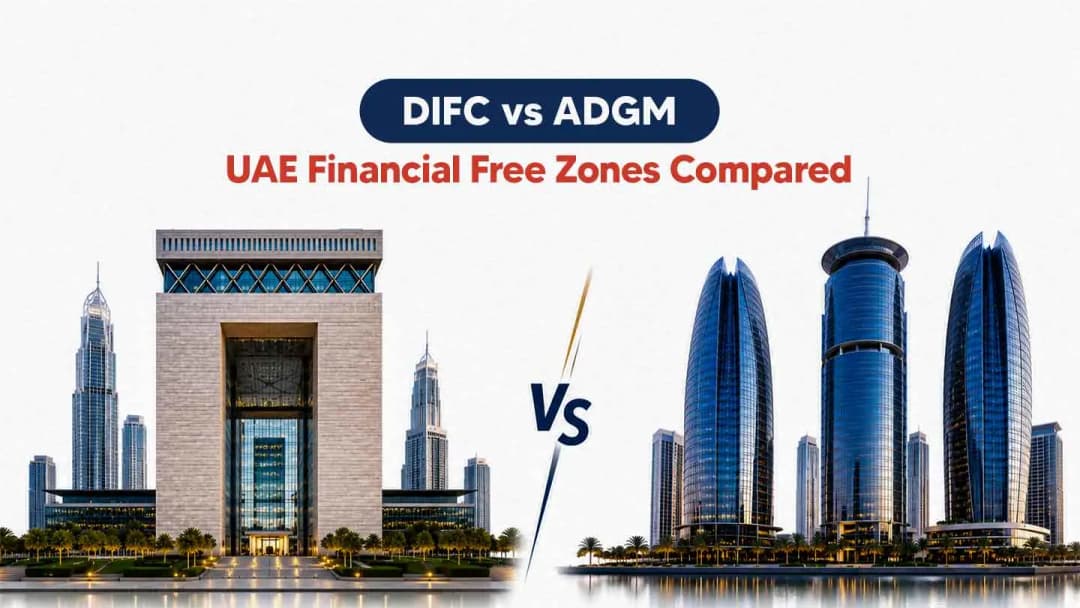
- ADGM (Abu Dhabi Global Market): Financial services, fintech, consulting
- TwoFour54: Media, content creation, digital services
- KEZAD: Industrial, manufacturing, logistics
- Masdar City: Clean technology, sustainable ventures
Key Advantages:
- 100% tax exemption (corporate and personal)
- Faster setup (typically 2-3 weeks)
- Flexible office solutions (virtual offices are available)
- Simplified customs procedures
Market Access Flexibility: Free zone companies now have clear pathways to operate in the mainland market through DET permits, establishing branch offices, or obtaining Dual License where available. This hybrid approach allows businesses to benefit from free zone incentives while accessing the wider UAE market.
Part 3: Legal Structures Available in Abu Dhabi
Choosing the right legal entity is crucial for liability, taxation, and growth. Here are your primary options:
Limited Liability Company (LLC)
- Best for: Most small to medium-sized businesses (mainland)
- Liability: Shareholders’ liability is limited to their capital contribution
- Ownership: Up to 100% foreign ownership is permitted
- Minimum Capital: Typically AED 300,000, but often not required to be fully deposited
- Requirements: Minimum of 1 shareholder and 1 director; physical office mandatory.
Free Zone Limited Liability Company (FZ-LLC)
- Best for: Export-focused businesses, tech startups, service providers
- Liability: Limited to share capital
- Ownership: 100% foreign ownership
- Capital: No minimum requirement in most free zones
- Requirements: Registered office within the free zone
Branch Office
- Best for: Foreign companies expanding to the UAE without forming a separate entity
- Liability: The Parent company bears full liability.
- Activities: Must match parent company’s activities
- Requirements: Appoint a local service agent (mainland) or registered agent (free zone)
Offshore Company
- Best for: holding assets, international trading, consulting, and investment.
- Jurisdiction: Jebel Ali (Dubai) or RAK ICC (Ras Al Khaimah)
- Operations: Cannot trade within the UAE local market
- Benefits: zero taxation, privacy, and minimal reporting.
Sole Establishment
- Best for: Individual entrepreneurs
- Liability: Unlimited personal liability
- Ownership: Single owner
- Requirements: Local service agent for non-GCC nationals
Need clarity on structure? Our consultants at Shuraa Business Setup analyse your business model, risk tolerance, and expansion plans to recommend the ideal legal entity.
Part 4: Documents Required for Abu Dhabi Business Setup
Having the right documents prepared saves weeks of delay. Here’s your comprehensive checklist:
For Individual Owners/Partners:
- Passport copies of all shareholders and directors (valid for a minimum of 6 months)
- Passport-size photographs with a white background
- A copy of the entry stamp or UAE residence visa if you are already in the UAE.
- No Objection Certificate (NOC) from the current sponsor (if employed in the UAE).
- Proof of address (utility bill or bank statement from home country)
- Curriculum Vitae (CV) with educational and professional background
For Corporate Shareholders:
- Certificate of Incorporation attested by the UAE Embassy
- Memorandum & Articles of Association attested
- Board Resolution authorising UAE investment
- Power of Attorney for appointed signatory
- Financial statements (last 2 years)
Additional Documents (Varies by Activity):
- Educational certificates attested (for professional licenses)
- Business plan (for certain free zones and banking)
- Previous experience certificates (trading/industrial licenses)
- Product catalogue or list (trading licenses)
- Factory layout/equipment list (industrial licenses)
Location-Specific Documents:
- Tenancy contract or Ejari (for the mainland)
- Lease agreement (free zone)
- Obtain an NOC from the building management if the office is located in a shared space.
Pro Tip from Shuraa: We provide clients with a personalised document checklist and handle the attestation and translation processes, ensuring 100% accuracy and faster approval.
Part 5: Choosing Your Business Activity – The Shuraa Framework™
Selecting the wrong activity code is the #1 mistake we see, it can limit expansion and increase costs. Use our proven 4-step framework:
Step 1: Revenue Model Test
- Service Activities: Consulting, marketing, IT services (lowest capital requirements)
- Trading Activities: Import/export, distribution (require higher capital and storage)
- Industrial Activities: Manufacturing and assembly (highest setup costs and approvals)
Step 2: Market Access Priority
- Local Market Focus: A Mainland license is often better.
- International/Export Focus: Free zone is usually optimal.
- Hybrid Model: Consider dual licensing strategies.
Step 3: Scalability Assessment
“We map your 3-year growth plan against license limitations,” says our Head of Licensing at Shuraa. “For example, a ‘Management Consulting’ license won’t allow you to sell products later without costly re-licensing.”
Step 4: Regulatory Fit Check
Some activities need special approvals:
- Healthcare: Ministry of Health approval
- Education: Department of Education approval
- Food Services: Food Control Authority clearance
- Engineering: Engineering Association membership
Part 6: Complete Cost Breakdown – No Hidden Surprises
Here’s what it actually costs to start a business in Abu Dhabi, based on Shuraa’s transparent pricing for 300+ annual setups:
Visible Costs (Budget for These):
| Cost Component | Mainland (DED) | Free Zone (Example) |
|---|---|---|
| Trade License | AED 15,000* – 30,000* | AED 12,000* – 25,000* |
| Office Space (Annual) | AED 40,000*+ | AED 5,000* – 50,000* |
| PRO Services | AED 5,000* – 8,000* | Often included |
| Total Visible | AED 60,000* – 78,000*+ | AED 17,000* – 75,000* |
Hidden Costs (Most Guides Don’t Mention):
Based on our client data, these add 15–25% to the initial budgets.
- Document Attestation: AED 500 – 2,000 (depending on country)
- Typing Centre Charges: AED 200 – 500 per application
- Compliance Certificates: AED 1,000 – 5,000 (varies by activity)
- Visa Medicals: AED 500 – 700 per person
- Bank Guarantees: AED 5,000 – 20,000 (refundable)
- Arabic Translation: AED 100 – 300 per document
Annual Renewal Costs:
- License Renewal: 80-100% of initial license fee
- Office rent typically increases by 5–10% annually.
- Visa Renewals: AED 3,000 – 5,000 per employee
“Smart Cost-Saving Strategy: Through Shuraa’s bulk processing relationships and optimised documentation, we typically save clients 20%+ on first-year costs compared to going alone.”
Important Note: The figures above are estimated ranges for planning purposes. Exact costs vary based on your specific business activity, structure, and location. Contact our experts for a free, personalized quotation.
Part 7: Your Week-by-Week Setup Timeline
Managing expectations is crucial. Here’s what actually happens:
Weeks 1-2: Preparation Phase
- Day 1-3: Initial consultation and business activity finalisation
- Day 4-7: Document preparation (passports, NOCs, business plan)
- Day 8-10: Name reservation and initial approval
- Day 11-14: Office space selection and agreement
Weeks 3-4: Submission Phase
- License application submission to DED or Free Zone Authority
- Additional approvals for specialised activities
- Draft a Memorandum of Association (for mainland)
Weeks 5-6: Processing Phase
- Government fee payments
- Visa application initiation for owners/staff
- Bank account opening preparation
Week 7-8: Completion Phase
- Trade license issuance
- First visa approvals
- Corporate bank account activation
With Shuraa’s streamlined process, 85% of straightforward setups are complete within 6-8 weeks.
Part 8: Step-by-Step Process – How to Start Your Business in Abu Dhabi
Starting a business in Abu Dhabi involves choosing a business activity, selecting a legal structure, registering your company, and obtaining the necessary licenses.
Step-by-Step Guide to Starting a Business
Step 1: Business Planning & Market Research
- Validate your concept with local potential customers
- Analyse the competitor landscape.
- Begin to determine the optimal legal structure (e.g., LLC, FZ-LLC, Branch) based on your initial findings.
Step 2: Understand Your Licensing Options
Your business model aligns with one of three Abu Dhabi license types:
- Mainland License (DED Abu Dhabi): Trade directly across UAE & internationally. 100% foreign ownership for most activities.
- Free Zone License: 100% ownership, tax exemptions, full profit repatriation. Operate within specific zones (like ADGM, KEZAD, Masdar City) with pathways to mainland access.
- Offshore License: For holding companies and international trade. Cannot operate within UAE but benefits from its legal and tax systems.
Need help choosing? Shuraa Business Setup can match your goals to the optimal license in a free consultation.
Step 3: Choose Your Jurisdiction & Location
- Finalize your Mainland vs. Free Zone decision using the framework above.
- Select the specific free zone or mainland location (city/area) that best suits your industry, target market, and budget.
Step 4: Reserve Your Trade Name
- Prepare 3-5 name options (in order of preference).
- Ensure names comply with UAE naming conventions.
- Submit for reservation, which typically takes 1-2 working days.
Step 5: Obtain Initial Approval
- Submit the preliminary application to the relevant authority:
- Department of Economic Development (DED Abu Dhabi) for mainland.
- The respective Free Zone Authority.
- Important: This is not your final license; it is the government’s initial permission to proceed with the setup.
Step 6: Prepare Legal Documents
- Draft the Memorandum of Association (for mainland LLCs).
- Finalize the Local Service Agent agreement (if applicable for professional mainland licenses).
- Execute the office lease agreement.
- Gather all required shareholder/partner documents (passports, CVs, etc.).
Step 7: Submit the Final Application
- Complete the main license application with all supporting documents.
- Pay all relevant government fees.
- Await processing (timelines vary by authority and activity complexity).
Step 8: Collect Your License & Start Operations
- Receive the physical trade license.
- Arrange for office signage (if required by your license).
- Commence your business activities legally.
Part 9: Common Pitfalls & How Shuraa Avoids Them for You
Pitfall #1: Underestimating Timeline
- Reality: Government processing times fluctuate. What took 4 weeks last month might take 6 now.
- Shuraa Solution: We maintain real-time relationships with processing officers across authorities, giving us visibility into actual timelines.
Pitfall #2: Activity Code Limitations
- Reality: Once licensed, adding new activities costs almost as much as a new license.
- Shuraa Solution: We future-proof your license by selecting activity codes that allow natural expansion.
Pitfall #3: Office Space Traps
- Reality: Many “affordable” spaces don’t meet DED requirements for visa quotas.
- Shuraa Solution: We vet locations against current regulations and negotiate better terms through our partner network.
Pitfall #4: Banking Challenges
- Reality: 30% of new businesses face unexpected bank account opening delays.
- Shuraa Solution: We prepare bank-ready documentation and leverage preferred relationships with 15+ UAE banks.
Part 10: Post-Setup Essentials
Visa Processing
- Investor/Partner Visas: For business owners
- Employee Visas: For your staff
- Family Sponsorship: Once you have your residence visa
- Domestic Worker Visas: For household help
Banking & Finance
- Corporate bank account setup (expect 2-4 weeks)
- A merchant account for payment processing
- Business credit facilities (after 6-12 months of operations)
- The company must register for VAT (mandatory if turnover exceeds AED 375,000, and optional from AED 187,500), which includes e-invoicing via Peppol CTC to ensure compliance by 2026.
Ongoing Compliance
- Annual license renewal
- Financial audit requirements
- VAT filing (if registered)
- Economic substance reporting (for certain activities)
FAQs – Abu Dhabi Business
1. How much does it cost to start a business in Abu Dhabi?
Costs range from AED 12,000 for basic free zone setups to AED 50,000+ for mainland commercial licenses, excluding office space and visas. The average total investment for a properly structured small business is AED 70,000-100,000 in year one.
2. How can I start my own business in Abu Dhabi as a foreigner?
As a foreigner, you can start by choosing between mainland (100% ownership in most sectors) or free zone companies, selecting your business activity, obtaining initial approvals, securing a location, and applying for your trade license through the DED or relevant free zone authority.
3. What is the best business to start in Abu Dhabi in 2026?
High-potential sectors include technology services (with AI/fintech focus), sustainable energy and agritech solutions, digital health and healthcare services, specialized tourism experiences, and niche e-commerce ventures serving the GCC market.
4. What is the cheapest business to start in the UAE?
Service-based businesses like consulting, digital marketing, or freelance services typically have the lowest startup costs, especially through free zones like Shams (Sharjah Publishing City) or Ajman Free Zone with packages starting from AED 6,000–9,000*.
5. How to start a small business in Abu Dhabi?
Begin with market research, choose between a mainland or free zone license based on your target customers, select a business activity, prepare required documents, apply for initial approval, secure office space (or flexi-desk), and complete license application through the relevant authority.
6. Which small business is most profitable in Abu Dhabi?
Specialized B2B services, technology integration firms, premium maintenance services for commercial properties, and niche health/wellness concepts currently show strong profitability due to Abu Dhabi’s infrastructure development and growing expatriate community.
7. Can I start a business in Abu Dhabi without living there?
Yes, through most free zones and certain mainland structures that don’t require resident partners. However, you’ll need to appoint a local manager and maintain a registered office address. Investor visas can be obtained once the business is established.
8. What documents do I need to start a business in Abu Dhabi?
Typically required: passport copies, visa/entry stamp, business plan, NOC from current sponsor (if resident), educational certificates, and any relevant professional qualifications. Specifics vary by activity and license type.
9. How long does it take to get a business license in Abu Dhabi?
For straightforward applications: 1–5 days for free zone licenses (up to 60 minutes via instant services), with full setup in 2–4 weeks; 2–4 weeks for mainland licenses via streamlined digital portals.
10. Do I need an office to start a business in Abu Dhabi?
Most licenses require a physical address. However, many free zones offer flexible options like flexi-desks, virtual offices, or shared spaces starting from AED 5,000/year, while mainland businesses typically need physical office space.
Related Business Setup Resources
- Understanding UAE Corporate Tax
- Complete UAE Residence Visa Process
- Choosing Between Mainland & Free Zone
- Business Bank Account Opening in the UAE
Ready to Transform Your Abu Dhabi Business Vision into Reality?
This guide has given you the knowledge, now you need the right partner.
At Shuraa Business Setup, we’ve helped over 100,000 entrepreneurs and corporations establish successful UAE businesses. Why navigate complex regulations alone when our DED-certified experts can:
- Provide 100% transparent pricing with no hidden fees
- Guarantee license approval with our error-free application process
- Save you weeks of time through our established authority relationships
- Offer ongoing support for visas, banking, and annual compliance
Take Your First Confident Step: Book your free, no-obligation business setup assessment with a Shuraa senior consultant today. We’ll analyze your specific needs and provide a clear roadmap and fixed-fee quotation within 24 hours.
Schedule Your Free Consultation Now | WhatsApp: +971507775554
Disclaimer: This guide reflects UAE regulations as of Jan 2026 and is regularly updated by Shuraa’s regulatory team. While comprehensive, it doesn’t replace personalized legal advice for your specific situation.
Leave a Comment
No comments yet. Be the first voice in the void.